
BIGBEAR
PHARMACEUTICAL

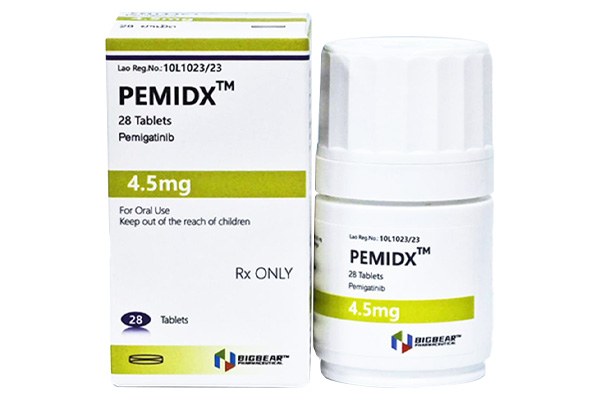
Pemigatinib is an oral targeted drug for the treatment of FGFR2 fusion‑positive advanced cholangiocarcinoma.

 AuthenticGuaranteeFast DeliveryPrivacy
 Pemigatinib is an oral, highly selective FGFR‑targeted inhibitor that can precisely inhibit the FGFR1/2/3 signaling pathway and block tumor cell proliferation.
For the treatment of adult patients with advanced, metastatic or unresectable cholangiocarcinoma who have received at least one prior systemic therapy and are confirmed to have FGFR2 fusion or rearrangement by testing.
Prior to initiating treatment with pemigatinib tablets in patients with locally advanced or metastatic cholangiocarcinoma, the presence of FGFR2 fusion or rearrangement must be confirmed using a validated test.
Patients identified as having FGFR2 fusion or rearrangement by hospital or laboratory genetic testing may receive this product.
FGFR2 genotyping should be performed using an investigational companion diagnostic assay at hospitals or laboratories designated by Innovent Biologics (Suzhou) Co., Ltd.
The recommended dose is 13.5 mg orally once daily, taken continuously for 14 days followed by 7 days off treatment, constituting a 21‑day treatment cycle.
Treatment should be continued until disease progression or unacceptable toxicity.
It is recommended to take the dose at approximately the same time each day.
Pemigatinib may be taken with or without food.
Tablets must be swallowed whole; do not crush, chew, split or dissolve the tablets.
If a dose is missed by more than 4 hours, or if vomiting occurs after dosing, the dose should not be made up that day.
The next prescribed dose should be taken at the scheduled time.
Pregnancy
Based on animal study results and its mechanism of action, pemigatinib may cause fetal harm or miscarriage when administered to pregnant women.
There are currently no data from pregnant women treated with pemigatinib.
Oral administration of pemigatinib to pregnant rats during organogenesis caused embryo malformation, embryo growth retardation, and embryo‑fetal death at maternal plasma exposures lower than the human clinical exposure at the 13.5 mg dose (see Animal Data).
Pregnant women should be informed of the potential risk to the fetus.
Animal Data
Once‑daily oral administration of pemigatinib to pregnant rats during organogenesis resulted in 100% embryo death, as post‑implantation loss occurred at doses ≥ 0.3mg/kg.
Once‑daily oral administration of 0.1mg/kg pemigatinib did not affect fetal survival rate; however, this dose caused decreased mean fetal body weight and increased incidences of fetal skeletal and visceral malformations, great vessel variations, and osteopenia.
Lactation
There are currently no data on the presence of pemigatinib or its metabolites in human milk, or on its effects on breastfed children or milk production.
Because pemigatinib may cause serious adverse reactions in breastfed children, women are advised not to breastfeed during treatment and for 1 week after the last dose.
Contraception
Pregnancy Testing
Prior to starting pemigatinib treatment, pregnancy status must be confirmed in females of reproductive potential.
Contraception
Pemigatinib may cause fetal harm when administered to pregnant women.
Fertility
Females of reproductive potential are advised to use effective contraception during pemigatinib treatment and for 1 week after the last dose.
Males with female partners of reproductive potential are advised to use effective contraception during pemigatinib treatment and for 1 week after the last dose.
The safety and efficacy of this product in pediatric patients below 18 years of age have not been established.
In Study CIBI375A201, only 1 patient was aged 65 years or older, and no patients were aged 75 years or older.In Study INCB 54828‑202, 31.5% of patients were aged 65 years or older, and 7.5% were aged 75 years or older.No overall differences in safety or efficacy were observed between these patients and patients younger than 65 years.
Common adverse reactions of pemigatinib include: hyperphosphatemia, alopecia, diarrhea, nail toxicity, fatigue, nausea, dysgeusia, stomatitis, constipation, dry mouth, dry eye, arthralgia, hypophosphatemia, dry skin and palmar-plantar erythrodysesthesia syndrome.
Common serious adverse reactions are hyponatremia and increased creatinine.
No serious adverse reactions leading to dose reduction of pemigatinib occurred.
One patient experienced a serious adverse reaction leading to dose interruption, which was hyponatremia.
One patient experienced a serious adverse reaction leading to discontinuation of pemigatinib, which was increased creatinine.
Hypersensitivity to the active ingredient or any excipient of this product.
Retinal Pigment Epithelial Detachment (RPED)
Pemigatinib may cause RPED, with clinical manifestations including blurred vision, floaters or photopsia.
Routine monitoring for asymptomatic RPED, including Optical Coherence Tomography (OCT), was not conducted in clinical trials of pemigatinib.
Therefore, the incidence of asymptomatic RPED induced by pemigatinib is currently unknown.
No cases of RPED occurred in the domestic clinical trial CIBI375A201.
Among 466 patients treated with pemigatinib in overseas clinical trials, 6% developed RPED, including 0.6% with Grade 3–4 RPED.
The median time to first onset of RPED was 62 days.
RPED led to dose interruption in 1.7% of patients, dose reduction in 0.4% of patients, and discontinuation of pemigatinib in 0.4% of patients.
Of the patients who required dose adjustment of pemigatinib due to RPED, 87.5% achieved symptom resolution or improvement to Grade 1.
Ophthalmological examination (including OCT) should be performed before initiating pemigatinib, every 2 months for the first 6 months of treatment, and every 3 months thereafter.
If visual symptoms develop, prompt medical attention should be sought, with follow-up examinations every 3 weeks until symptoms resolve.
Dose adjustment or permanent discontinuation of pemigatinib should be performed as recommended.
Dry Eye Disease
In clinical trial CIBI375A201, among 31 patients treated with 13.5 mg pemigatinib, 16.1% developed dry eye disease, all of which were less than Grade 3 in severity.
In clinical trial INCB 54828-202, among 466 patients treated with pemigatinib, 27% developed dry eye disease, including 0.6% with Grade 3–4 severity.
Ophthalmic lubricants should be administered as needed.
Pemigatinib may cause hyperphosphatemia.
Long-standing hyperphosphatemia may lead to soft tissue mineralization, cutaneous calcification, calcinosis and non-uremic calciphylaxis.
Elevated phosphate concentration is a pharmacodynamic effect of pemigatinib.
In clinical trial CIBI375A201, among 31 patients treated with oral 13.5mg pemigatinib, 96.8% developed hyperphosphatemia (laboratory values above the upper limit of normal).
The median time to first onset of hyperphosphatemia was 8 days (range 5–177 days), and 38.7% of patients required phosphate-lowering therapy.
In clinical trial INCB 54828-202, among 466 patients treated with pemigatinib, 92% developed hyperphosphatemia (laboratory values above the upper limit of normal).
The median time to first onset of hyperphosphatemia was 8 days (range 1–169 days), and 29% of patients required phosphate-lowering therapy.
Patients should be monitored for hyperphosphatemia.
A low-phosphate diet should be initiated when serum phosphate concentration is > 5.5mg/dL.
For serum phosphate concentration > 7 mg/dL, phosphate-lowering therapy should be started, and pemigatinib may be interrupted, dose-reduced or permanently discontinued based on the duration and severity of hyperphosphatemia.
Based on animal study results and its mechanism of action, pemigatinib may cause fetal harm when administered to pregnant women.
Oral administration of pemigatinib to pregnant rats during the organogenesis period caused embryonic malformation, embryonic growth retardation and embryo-fetal death at maternal exposures lower than human exposure at the clinical dose of 13.5 mg (based on area under the curve [AUC]).
Pregnant women should be informed of the potential risk to the fetus.
Females of reproductive potential and their partners are advised to use effective contraception during treatment with pemigatinib and for 1 week after the last dose.
Pemigatinib may have a potential (moderate) effect on the ability to drive and use machines.
Pemigatinib may cause adverse reactions such as fatigue and blurred vision.
Therefore, caution should be exercised when assessing patients’ ability to drive or operate machinery.
If any issues arise, please contact us immediately.
Email:laosbigbear@gmail.com

Take your dose as soon as you remember. However, if it has been more than 4 hours since your scheduled dose, skip the missed one. Do not take a double dose to make up for it.
Seek immediate emergency medical help or call the Poison Help hotline.
Grapefruit and grapefruit products may interact with pemigatinib and increase the risk of adverse side effects. Therefore, avoid consuming grapefruit products during treatment.
Certain medications should not be used together due to safety concerns. Some drugs can alter blood concentrations of other medications you are taking, potentially increasing side effects or reducing treatment effectiveness.
Various medications may interact with pemigatinib, including prescription drugs, over‑the‑counter products, vitamins, and herbal supplements. Inform your doctor about all medications you are currently taking, as well as any you start or stop using.
Copyright2024@ BIGBEAR All right reserved Bigbear | Bigbear Pharmaceutical | Bigbear Laos


